As we often do, last night I received a call from dear old nana calling on behalf of her cherished loin-fruit, who in turn is calling on behalf of the darling cherubim of a grandson. I forget the name, but as these calls are often near-identical, I would place good money that he is either a Cain/Kane, Kaden/Zaden, a Tyler or a Taylor. I also once had a Christofa. No lie. Of course, the reason for the gran intermediary is, as is always the case, that mum is cruelly sundered from our welcoming arms by a pay as you go mobile, our local call-rate and the amount left of this month's giro. So it goes.
So, nana tells me in the vaguest of terms of the child's general illness: his fever, a bit of a headache, all in the last day or so (sadly, in our society of instantaneous wish-fulfillment and bloated sense of entitlement, we refuse to admit that anything so hideous as a high temperature might afflict our children for so much as a night without the doctor racing out to cure it for us as Britain's Got Talent drones in the background), that he's 'not right well', and 'like an oven'. Since her daughter and grandchild are, however, on yonder side of Bradford I decide just to ring her myself and get the hopefully more accurate down-low. So I take mum's phone number, her name, and, as per protocol, tell her to alert mum to the call before I get in touch with her.
I try the mobile number and... it's a dud. I try again - no dice. Thus I call dear old Nana back to clarify the number, but, of course, it's engaged. I try again five minutes later... still engaged. Obviously someone must've mentioned this week's Coronation Street in passing. So, as an adjunct to merely sitting there cupping my balls in contemplation, I search our previous records for any record pertaining to the child (of whom I have only a name, a vague location and an age but no specific DOB) and find a record that might, might just be the one. So I opens it up, and it's the wrong one. I can tell straight away - wrong side of the city, wrong age. But, something catches my eye in the previous call reason. And here I stand and tentatively clear my throat in anticipation as I read it:
'swollen penis, painful pussy 2 days'.
Now, I will admit that my colleagues' spelling is about on par with an adolescent gibbon at the best of times. But the surety of it, the lack of any kind of punctuation between 'painful' and 'pussy', well... it just makes me proud that we're here for those moments when even hermaphrodites lose their good judgement and don't use a condom with themselves.
This was possibly the most needlessly complex penis gag I've ever told.
Friday, 23 April 2010


Sunday, 11 April 2010
Tim Westwood

'Hence it is, that the children of bishops carry about with them an austere and repulsive air, indicative of claims not generally acknowledged, a sort of noli me tangere manner, nervously apprehensive of too familiar approach, and shrinking with the sensitiveness of a gouty man.' Thomas De Quincey, Confessions of an English Opium Eater (1821).
Friday, 2 April 2010
FC-KR Derby
As something of an expatriate Hull KR fan (having emigrated from family territory in East Hull to, well, more of the Westward fringes) I'm obviously seething from the recent loss to the monochromatic bastards. Tight one mind you, and we're still leading in terms of total derbys won, but it's always a sore blow. As I was just going downstairs to fetch a cup of tea though, it occurred to me how absurd the fanatic, die-hard loyalty that surrounds clubs can be. While the hardened Rovers fans scream for the will of the Robin-God himself to be unleashed on t'other bastards, the righteous fury is actually coolly delivered by what looks more like a touring Australasian bodybuilding group.
Although it's something I have little to no interest in, football is much the same, if not worse. Quite simply, why cheer for your city out there when nobody on the pitch is actually from the bloody place? Yet the bloody-minded fanaticism of most suggests that most fans haven't factored-in that their team is essentially just a superfluous badge for a succession of preening dicks in hairbands. Since I rarely take note of football, every time I look it seems a uniquely Heraclitean experience: as he tells us that you can never step into the same river twice, I can never seem to look at the same bloody club twice either. Actually, Roberto Bolano prefaces his Nazi Literature of the Americas with a cute refutation of this by Augusto Monterroso: 'If the flow is slow enough and you have a good bicycle, or a horse, it is possible to bathe twice (or even three times, should your personal hygiene so require) in the same river.' So, I'm pretty much guessing that this is how Talksport phoners-in still manage to stay bothered then.
Although it's something I have little to no interest in, football is much the same, if not worse. Quite simply, why cheer for your city out there when nobody on the pitch is actually from the bloody place? Yet the bloody-minded fanaticism of most suggests that most fans haven't factored-in that their team is essentially just a superfluous badge for a succession of preening dicks in hairbands. Since I rarely take note of football, every time I look it seems a uniquely Heraclitean experience: as he tells us that you can never step into the same river twice, I can never seem to look at the same bloody club twice either. Actually, Roberto Bolano prefaces his Nazi Literature of the Americas with a cute refutation of this by Augusto Monterroso: 'If the flow is slow enough and you have a good bicycle, or a horse, it is possible to bathe twice (or even three times, should your personal hygiene so require) in the same river.' So, I'm pretty much guessing that this is how Talksport phoners-in still manage to stay bothered then.
Wednesday, 31 March 2010
James Wright
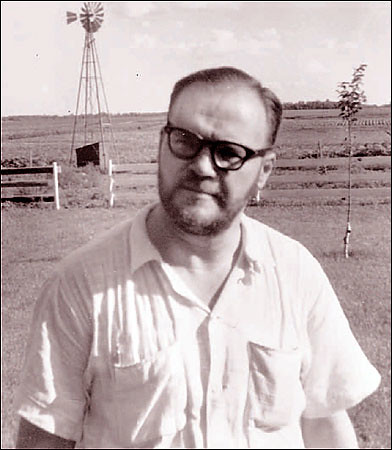
Once I got over Wright's constant insistence on a very pure manner of practically Horatian craftsmanship - not to mention his predilection for over-obvious rhyming couplets that make you cringe at the sheer clanging sound - I found a succinct poet of humbleness and sublimity. Ostensibly a nature poet, he's one with fierce ties to the industrial working class, and a sense of the constant ghost of his birthtown of Martin's Ferry, Ohio that flavours his work the same way Detroit does for Philip Levine. Anyway, I'm not bloody wikipedia, I'm just saying that it's exciting to find someone new that honestly impresses me. I feel guilty, though, that I've not been able to feel as excited about any British poets for a long time, something that the recent watery mulch of the National Poetry award-winners has only served to prolong I'm sad to say.
Here's a bit of Wright's I admire from 'The Frontier':
A girl stands in a doorway.
Her arms are bare to the elbows,
Her face gray, she stares coldly
At the daybreak.
When the howl goes up, her eyes
Flare white, like a mares.
I gulped the whole stanza in one go and, as the collected inflections, meanings and associations settled, I was amazed to feel that little shiver you feel when something truly stands out for you. I don't want to analyse it for exactly that reason.
Wright's classical dedication to the sheer craft of form gave me something of a second thought. Though I always considered form essentially an archaic, sing-song affectation thrown in for sheer technical diversity in creative-writing classes, I've come to realise the difference that it can really make in the inception of a poem. Obviously no vers is libre for the man who wants to do a good job, as our boy TS never tires of telling us, but in composition the prosodic rhymes are essentially just replaced with semantic ones. With a free rein, it's all too easy to fall into a similar path of associations at times, and, as Thom Gunn remarked, even the act of laboriously reading out every possible permutation of a rhyme can be immensely liberating and force a change in direction or approach that the pacey ramble of free verse could never happen upon.
Wright decided never to write again, that he'd said everything he could possibly say. Then, after the emotional and spiritual vacillations of breakdown and an epiphany, he returned with This Branch Will Not Break and Shall We Gather at the River, loosening his formalist tendencies of old. But again, I am not Wikipedia. Here's a bit from the final poem, 'To the Muse', from Shall We Gather at the River where, as far as I see, there's a tender emergence of the lost loved one and a bitter candour similar to that found at the end of Bunting's 'Briggflatts'. Although the baldness of his sentiment initially rankled to one such as me - raised with the sickly veneer of postmodern, smartarse irony daubed hideously over everything - it still managed to ring clear with me somehow. I can't help but feel that in itself that's an achievement:
You come up after dark, you poise alone
With me on the shore.
I lead you back into this world.
Three lady doctors in Wheeling open
Their offices at night.
I don''t have to call them, they are always there.
But they only have to put the knife once
Under your breast.
Then they hang their contraption.
And you bear it.
It's awkward a while. Still, it lets you
Walk about on tiptoe if you don't
Jiggle the needle.
It might stab your heart, you see.
The blade hangs in your lung and the tube
keeps it draining.
That way they only have to stab you
Once. Oh Jenny.
I wish to God I had made this world, this scurvy
And disastrous place. I
Didn't, I can't bear it
Either, I don't blame you, sleeping down there
Face down in the unbelievable silk of spring.
Muse of black sand,
Alone.
I don't blame you, I know
The place where you lie.
I admit everything. But look at me.
How can I live without you?
Come up to me, love,
Out of the river, or I will
Come down to you.
Sunday, 7 March 2010
Spring (2)

I noticed that a lot of poets I love have a sly spring poem or two hidden up their respective sleeves. They just can't leave it alone. Here're a few:
Ode 1
Weeping oaks grieve, chestnuts raise
mournful candles. Sad is spring
to perpetuate, sad to trace
immortalities never changing.
Weary on the sea
for sight of land
gazing past the coming wave we
see the same wave;
drift on merciless reiteration of years;
descry no death, but spring
is everlasting
resurrection.
Basil Bunting
***
Spring Rain
Now the rain is falling, freshly, in the intervals between sunlight,
a Pacific squall started no one knows where, drawn east as the drifts of
warm air make a channel;
it moves its own way, like water or the mind,
and spills this rain passing over. The Sierras will catch it as last snow
flurries before summer, observed only by the wakened marmots at ten
thousand feet,
and we will come across it again as larkspur and penstemon sprouting
along a creek above Sonora Pass next August,
where the snowmelt will have trickled into Dead Man's Creek and the
creek spilled into the Stanislaus and the Stanislaus into the San Joaquin
and the San Joaquin into the slow salt marshes of the bay.
That's not the end of it: the gray hays of the mountains eat larkspur seeds,
which cannot propagate otherwise.
To simulate the process, you have to soak gathered seeds all night in the
acids of coffee
and then score them gently with a very sharp knife before you plant them
in the garden.
You might use what was left of the coffee we drank in Lisa's kitchen
visiting.
There were orange poppies on the table in a clear glass vase, stained
near the bottom to the color of sunrise,
the unstated theme was the blessedness of gathering and the blessing of
dispersal-
it made you glad for beauty like that, casual and intense, lastng as long
as the poppies last.
Robert Hass
***
Some haikus by Matsuo Basho:
First day of spring-
I keep thinking about
the end of autumn.
The spring we don't see-
on the back of a hand mirror
a plum tree in flower.
A village without bells-
how do they live?
spring dusk.
***
Spring
Green-shadowed people sit, or walk in rings,
Their children finger the awakened grass,
Calmly a cloud stands, calmly a bird sings,
And, flashing like a dangled looking-glass
Sun lights the balls that bounce, the dogs that bark,
The branch-arrested mist of leaf, and me,
Threading my pursed-up way across the park,
An indigestible sterility.
Spring, of all seasons most gratuitous,
Is fold of untaught flower, is race of water,
Is earth's most multiple, excited daughter;
And those she has least use for see her best,
Their paths grown craven and circuitious,
Their visions mountain-clear, their needs immodest.
Philip Larkin
***
Haikus by Kobayashi Issa:
In spring rain
a pretty girl
yawning.
Spring rain:
a mouse is lapping
the Sumida River.
***
Spring and All
By the road to the contagious hospital
under the surge of the blue
mottled clouds driven from the
northeast - a cold wind. Beyond, the
waste of broad, muddy fields brown with dried weeds, standing and fallen
patches of standing water
the scattering of tall trees
All along the road the reddish
purplish, forked, upstanding, twiggy
stuff of bushes and small trees
with dead, brown leaves under them
leafless vines -
Lifeless in appearance, sluggish
dazed spring approaches -
They enter the new world naked,
cold, uncertain of all
save that they enter. All about them
the cold, familiar wind -
Now the grass, tomorrow the stiff curl of wildcarrot leaf.
One by one objects are defined -
It quickens: clarity, outline of leaf
But now the stark dignity of
entrance - Still, the profound change
has come upon them: rooted, they
grip down and begin to awaken
William Carlos Williams
***
Some Haikus by Yosa Buson:
A moored boat;
where
did the spring go?
The end of spring
lingers
in the cherry blossoms.
Wading through it
her feet muddied
the spring current.
Spring.
I only thought of spring the other day. I usually pay less attention to it than the other seasons because, essentially, it's summer-lite. Just as autumn is winter-lite in fact, except that most people lie in order to look profound and exclaim that it's actually their most favourite season of all. Like, totally deep, man. How sublime and aesthetic, the deep ochre palette of mother earth brimming to the fore just as nature beds down on the wane dude. Lies. Granted, though, autumn does have big piles of leaves to kick, just as summer has (theoretically anyhow) lots of warm weather and winter has snow, spring doesn't really have any instant, tangible appeal in that way. For all I know it could be summer now, seeing as, what with the onset of global warming and all, spring is apparently starting earlier than ever now (). Plus, it was quite sunny today.
The reason that I noticed though was that, outside my bedroom window there's a rather tall tree about one house away. Actually it's the garden that backs on to ours, whatever that makes it. Anyway, I noticed that it looks particularly gorgeous on a starry night in winter, its spindly limbs framed against the starlight and so on. Now, having taken out (and subsequently lost) both of my piercings I now feel postively naked. And a total average Joe to boot. As such, I've given greater thought to a tattoo (please bear with me on this non sequitur ramble) and the plan for an upper arm sleeve. I have no intention of getting anything in old english or chinese, or to 'commemorate' anything mind you, I'm more of the school that, if you're going to do something, do it properly. So, I want to have it done well, and relatively artistically. My idea was to get the image of that tree framed against the stars on my upper arm as a sleeve, although first I needed a picture of it. Last time I thought of this was a good 2 summers ago, but then I missed winter. Don't ask me how. I missed it. An entire season. No photo. I remembered this and cursed the heavens in a particularly vigorous and colourful manner. But, upon looking out, I realised that it hadn't actually begun to blossom yet. So in that way I was happy, despite spring apparently starting earlier. I'd kind of intended this post to be a list of some spring poems, but I see now that I've over-rambled somewhat, so I'll bundle it into a separate one methinks.
The reason that I noticed though was that, outside my bedroom window there's a rather tall tree about one house away. Actually it's the garden that backs on to ours, whatever that makes it. Anyway, I noticed that it looks particularly gorgeous on a starry night in winter, its spindly limbs framed against the starlight and so on. Now, having taken out (and subsequently lost) both of my piercings I now feel postively naked. And a total average Joe to boot. As such, I've given greater thought to a tattoo (please bear with me on this non sequitur ramble) and the plan for an upper arm sleeve. I have no intention of getting anything in old english or chinese, or to 'commemorate' anything mind you, I'm more of the school that, if you're going to do something, do it properly. So, I want to have it done well, and relatively artistically. My idea was to get the image of that tree framed against the stars on my upper arm as a sleeve, although first I needed a picture of it. Last time I thought of this was a good 2 summers ago, but then I missed winter. Don't ask me how. I missed it. An entire season. No photo. I remembered this and cursed the heavens in a particularly vigorous and colourful manner. But, upon looking out, I realised that it hadn't actually begun to blossom yet. So in that way I was happy, despite spring apparently starting earlier. I'd kind of intended this post to be a list of some spring poems, but I see now that I've over-rambled somewhat, so I'll bundle it into a separate one methinks.
Tuesday, 2 March 2010
Chronic Douche moments courtesy of the Paris Review.
Interviewer: You mentioned economic freedom. Does the writer need it?
Faulkner: No. The writer doesn’t need economic freedom. All he needs is a pencil and some paper... Success is feminine and like a woman; if you cringe before her, she
will override you. So the way to treat her is to show her the back
of your hand. Then maybe she will do the crawling.
***
Interviewer: Despite the great variety of the characters you have created in your novels, it is very noticeable that you have never given a sympathetic or even a full-scale portrait of a working-class character. Is there any reason for this?
Waugh: I don't know them, and I'm not interested in them. No writer before the middle of the nineteenth century wrote about the working classes other than as grotesques or as pastoral decorations. Then when they were given the vote certain writers started to suck up to them.
Wow.
Also, interestingly enough:
Interviewer: What do you think of American writers? F.Scott Fitzgerald or William Faulkner, for example?
Waugh: I find Faulkner intolerably bad.
Faulkner: No. The writer doesn’t need economic freedom. All he needs is a pencil and some paper... Success is feminine and like a woman; if you cringe before her, she
will override you. So the way to treat her is to show her the back
of your hand. Then maybe she will do the crawling.
***
Interviewer: Despite the great variety of the characters you have created in your novels, it is very noticeable that you have never given a sympathetic or even a full-scale portrait of a working-class character. Is there any reason for this?
Waugh: I don't know them, and I'm not interested in them. No writer before the middle of the nineteenth century wrote about the working classes other than as grotesques or as pastoral decorations. Then when they were given the vote certain writers started to suck up to them.
Wow.
Also, interestingly enough:
Interviewer: What do you think of American writers? F.Scott Fitzgerald or William Faulkner, for example?
Waugh: I find Faulkner intolerably bad.
Subscribe to:
Posts (Atom)